Most teams do not have a task shortage.
They have a priority problem.
The board is full. Messages keep arriving. A client needs a follow-up. A proposal is due tomorrow. Marketing wants feedback. Operations has a blocker. Everyone is working, yet the question keeps returning:
What should I work on first?
For a small team, a manager can answer that manually. As the business grows, that approach stops scaling. Priorities change throughout the day, important work gets buried under visible work, and people spend more time deciding what to do than actually doing it.
The next generation of task software should not only store work. It should help teams understand which work deserves attention now.
A task list gives you work. It does not give you judgment.
Traditional task systems are good at recording information: title, assignee, deadline, status, checklist, project.
That structure matters. TrueValue Platform Task is designed to support assigned work and operational follow-through, helping teams organise tasks and track work as it moves through the process.
Explore the wider TrueValue Platform product ecosystem.
But once a team has dozens or hundreds of active items, another problem appears.
Two tasks can both be marked “high priority” while having completely different business impact. A task due today may be routine. A task due tomorrow may block a client, a deal or three other employees. A quiet task with no urgent notification may be the one that creates the biggest cost if it slips.
Priority cannot always be reduced to a coloured label.
Priority Prediction starts with context
Imagine opening your workday and asking:
“What needs my attention first?”
Instead of returning the newest tasks or simply sorting by due date, an intelligent system could evaluate the context around the work.
A future priority-prediction system could potentially consider signals such as deadlines, dependencies, SLA risk, customer impact, task age, project status, ownership and the effect of delaying an item.
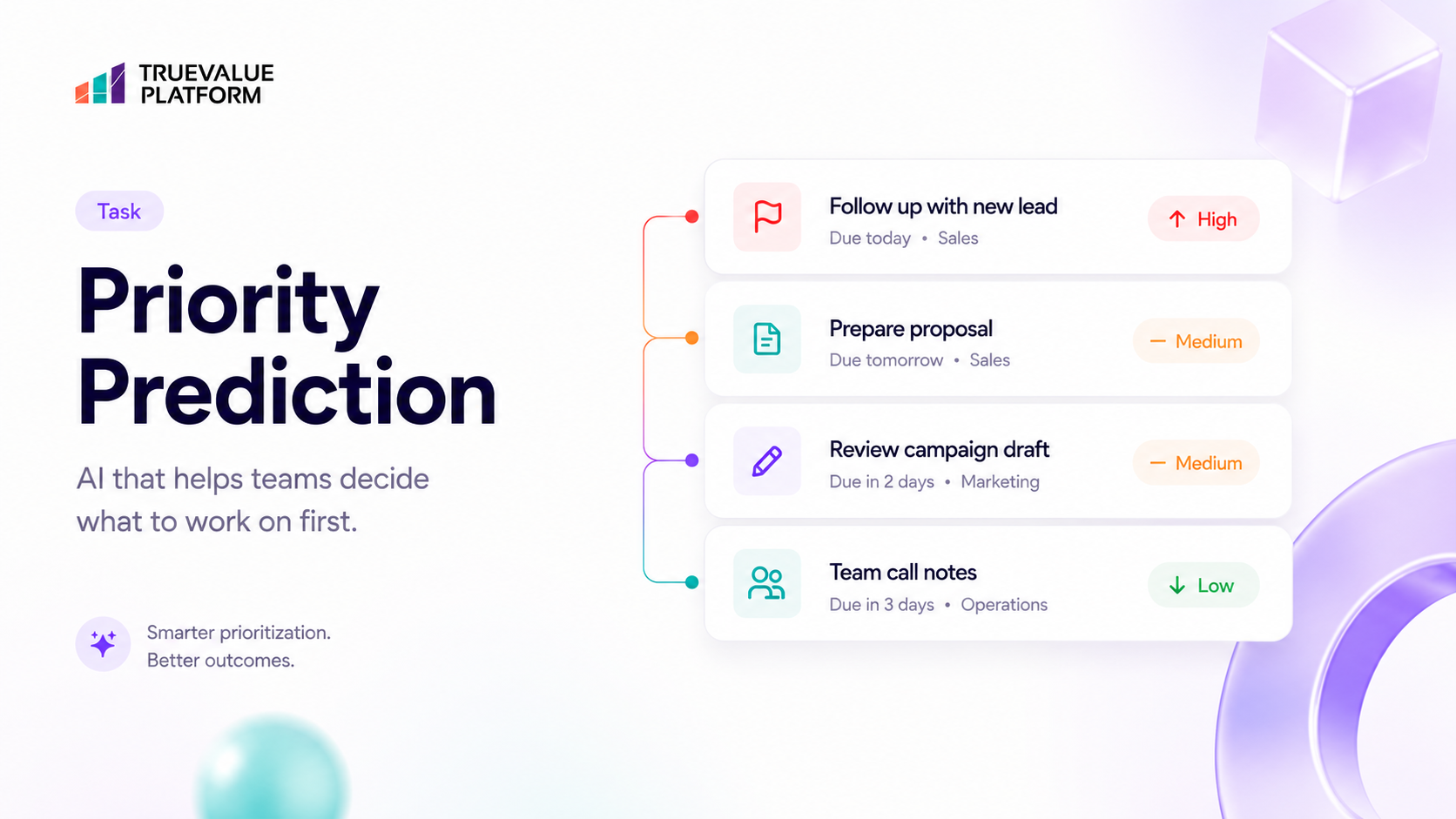
The output should not be another complicated dashboard.For example, a hypothetical system might surface recommendations such as:
Follow up with new lead — HighPrepare proposal — MediumReview campaign draft — MediumTeam call notes — Low
The value is not the label itself.
The value is reducing the time between seeing work and understanding where to focus.
Good AI should reduce decisions, not create more noise
AI inside business software is often presented as a collection of features: summaries, assistants, prompts, predictions and automations.
That is not enough.
Useful AI should remove a specific point of friction.
In task management, one of those friction points is constant reprioritisation. Managers repeatedly scan boards. Employees interrupt each other to ask what matters. Teams respond to whichever notification feels loudest.
A better system would surface the few tasks most likely to need attention and explain why.
For example:
“This client follow-up is due today and has no completed next action.”
“This proposal affects a deal currently waiting on your response.”
“This campaign review can wait because no dependent work is blocked.”
The AI is not replacing ownership. It is making the decision environment clearer.
For another perspective on this problem, read Why Work Gets Delayed When Task Ownership Is Unclear.
Priority becomes more useful when work is connected
Task intelligence becomes more powerful when a task is not isolated from the rest of the business.
TrueValue Platform is built around connected products including CRM, Appointments, Site Flow, Task, HR, Payroll, Marketing and PBX. TrueValue Platform brings purpose-built Products together through shared platform identity, permissions and connected workflows.
That connected model matters because priority often depends on information outside the task itself.
A sales follow-up may matter because of the lead behind it.
An onboarding task may matter because a new employee starts tomorrow.
A website request may matter because it is connected to an active customer workflow.
When business context and task context live closer together, recommendations can become more relevant than a simple “urgent” flag.
Businesses can also explore how connected workflows may apply across Professional Services, Real Estate, Visa & Immigration, Healthcare, Education, IT Services and E-commerce through TrueValue Industry Solutions.
The goal is not to automate the manager
Managers should still decide what matters strategically.
Teams should still be able to override recommendations.
And people should still understand why a task is important.
The role of AI is to make the first pass faster: review the signals, identify likely risks, surface the work that deserves attention and give the team a better starting point.
That is a more practical future for AI at work.
Not another chatbot floating beside your dashboard.
Not another page of analytics.
Just a clearer answer to a question every team asks every day:
What should we work on first?
TrueValue Platform currently describes smart recommendations, natural-language search and other intelligence capabilities as planned future development, while TrueValue Task is a Launched Product within the TrueValue Platform ecosystem.
To explore the current platform and see how connected CRM, Task, Site Flow, Appointments and other products could fit your workflow, request a personalised TrueValue Platform demo.