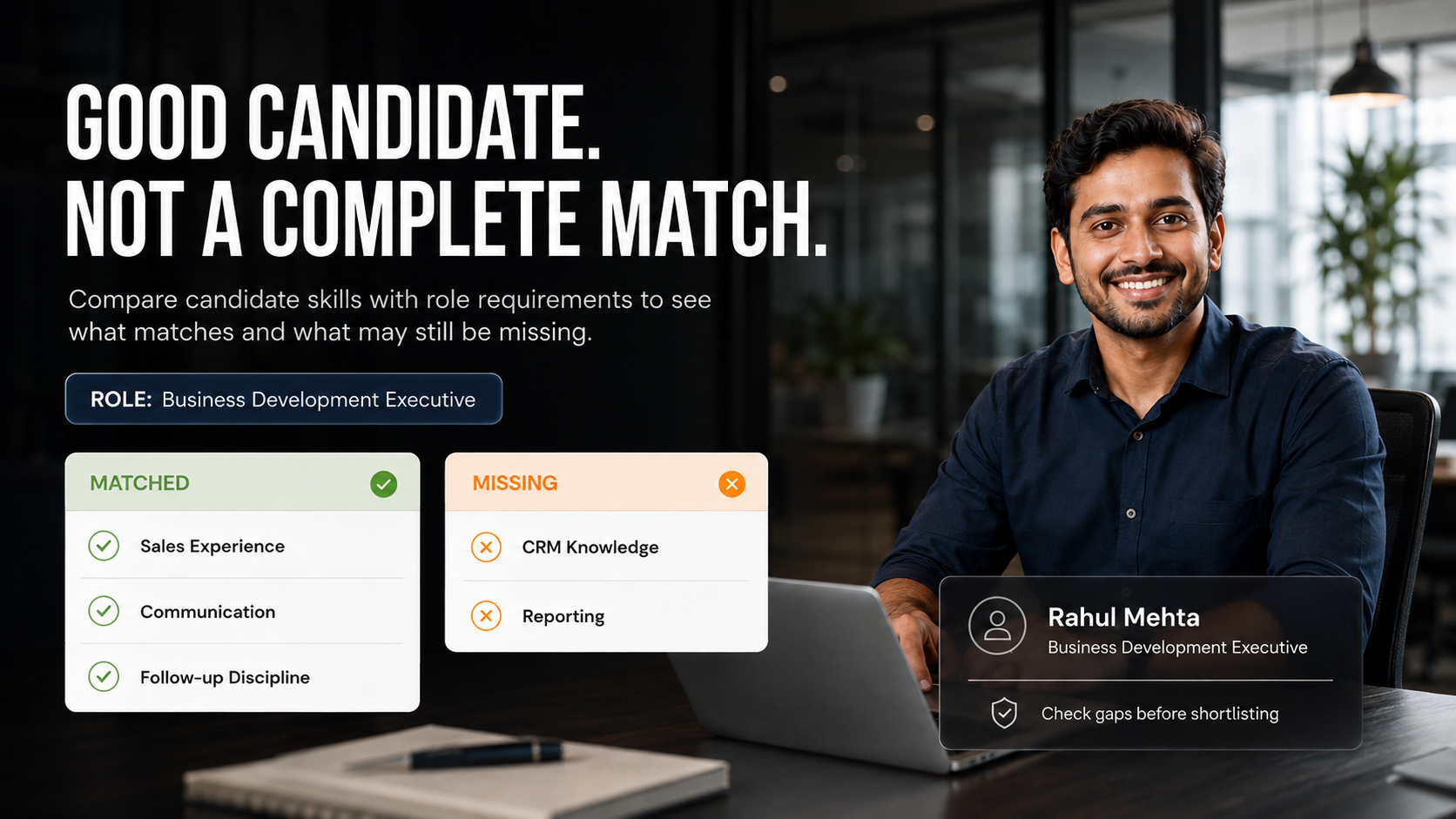
A candidate can look promising without matching every requirement in a job description. That is normal. The better hiring question is not, “Does this person tick every box?” It is: “Which requirements are supported by evidence, which need verification, and which gaps genuinely matter?”
A missing keyword on a CV is not always a missing capability. A better shortlisting process compares role requirements with candidate evidence, then turns uncertainty into better screening questions.
If your team already uses a structured CV summary, the next step is to compare that evidence directly with the vacancy requirements.
Not Every Missing Skill Should Mean Rejection
Before reviewing candidates, separate requirements into three groups:
Essential from day one: capabilities the person must already have to perform the role effectively.
Important but trainable: skills that matter but can reasonably be developed after joining.
Helpful rather than essential: experience that strengthens a profile but should not automatically decide the shortlist.
Imagine a Business Development Executive role requiring sales experience, communication, follow-up discipline, CRM knowledge and reporting. A candidate may show strong evidence for the first three but little evidence for CRM and reporting.
That does not automatically mean “reject”. Has the candidate never used a CRM, used a different system, or simply failed to describe that experience clearly? The shortlist should be based on evidence, not terminology alone.
Compare Evidence, Not Just Skill Labels
For every important requirement, ask four questions:
What does the role actually require? Define the capability or outcome.
What evidence does the candidate provide? Look at work history, projects, qualifications or examples.
How strong is that evidence? Is it direct, related, unclear or absent?
What should happen next? Shortlist, verify, ask in interview or treat it as a meaningful gap.
For example, “CRM knowledge” is only a label. Better evidence might include managing lead stages, recording follow-ups, maintaining customer records or updating deal information.
This changes screening from:
“Is CRM written on the CV?”
to:
“What evidence shows this person understands the workflow the role requires?”
That is a much more useful hiring question.
Use Three Buckets: Matched, Needs Verification, Missing
A matched-versus-missing view is useful, but hiring decisions often need a third category: needs verification.
Matched means there is reasonably clear evidence for the requirement.
Needs verification means the CV suggests relevant experience, but the evidence is incomplete or vague.
Missing means there is no meaningful evidence and the gap appears relevant to the role.
That middle category matters. Without it, recruiters can create false certainty: rejecting someone for experience they failed to describe, or shortlisting someone because a skill was mentioned without proof.
This is why AI-assisted candidate screening should support review rather than replace it. Technology can help organise candidate information and surface useful context. Recruiters still need to verify the evidence and decide what matters for the vacancy.
Turn Gaps Into Better Interview Questions
A useful gap analysis should improve the next conversation.
Instead of asking:
“Do you know CRM?”
ask:
“Walk me through how you tracked prospects, follow-ups and deal stages in your previous role.”
Instead of:
“Are you good at reporting?”
ask:
“What sales information did you report to your manager, and how did you prepare it?”
These questions can reveal whether an apparent gap is real, trainable or simply poorly represented on the CV.
That is the practical value of identifying what is missing: the gap becomes something to investigate rather than an automatic reason to reject.
Where TrueValue Platform Recruit Fits
TrueValue Platform Recruit supports jobs, candidates, hiring pipelines, interviews, offers and successful-hire handoff. Recruit also includes verified AI-assisted candidate screening and interview-related capabilities within that broader hiring workflow.
AI can help recruiters organise information and prepare for decisions, but the final hiring decision still requires human assessment.
A practical model is:
Organise the evidence → compare it with the role → verify unclear areas → make the decision with human judgement.
The goal is not to turn candidates into scores or checklists. It is to give recruiters clearer context before they make an important decision.
A Practical Shortlisting Checklist
Before moving a candidate forward, check:
Have we identified the genuine must-have requirements?
Do matched skills have supporting evidence?
Are any “missing” skills actually unverified?
Can trainable gaps be separated from deal-breakers?
Have we turned uncertainty into specific interview questions?
Frequently Asked Questions
Should a candidate match every requirement before being shortlisted?
Not necessarily. Separate essential requirements from trainable or preferred capabilities, then assess the importance of each gap in context.
Is a skill listed on a CV enough evidence?
No. Treat it as a starting point and look for responsibilities, examples, qualifications or interview evidence that supports it.
Can AI decide whether a candidate is suitable?
AI-assisted tools can support screening and organise relevant information, but important hiring decisions should remain with people who can evaluate context and evidence.
Shortlist for Evidence, Not Perfection
The strongest candidate is not always the person whose CV appears to match the most keywords. A better process identifies what the role genuinely requires, checks what the candidate can demonstrate and investigates the gaps that matter.
When you can see both the match and the missing context, shortlisting becomes a structured decision rather than a quick impression.
Ready to explore a more organised, AI-assisted hiring workflow? Request a Demo to see how TrueValue Platform Recruit can support your recruitment process.