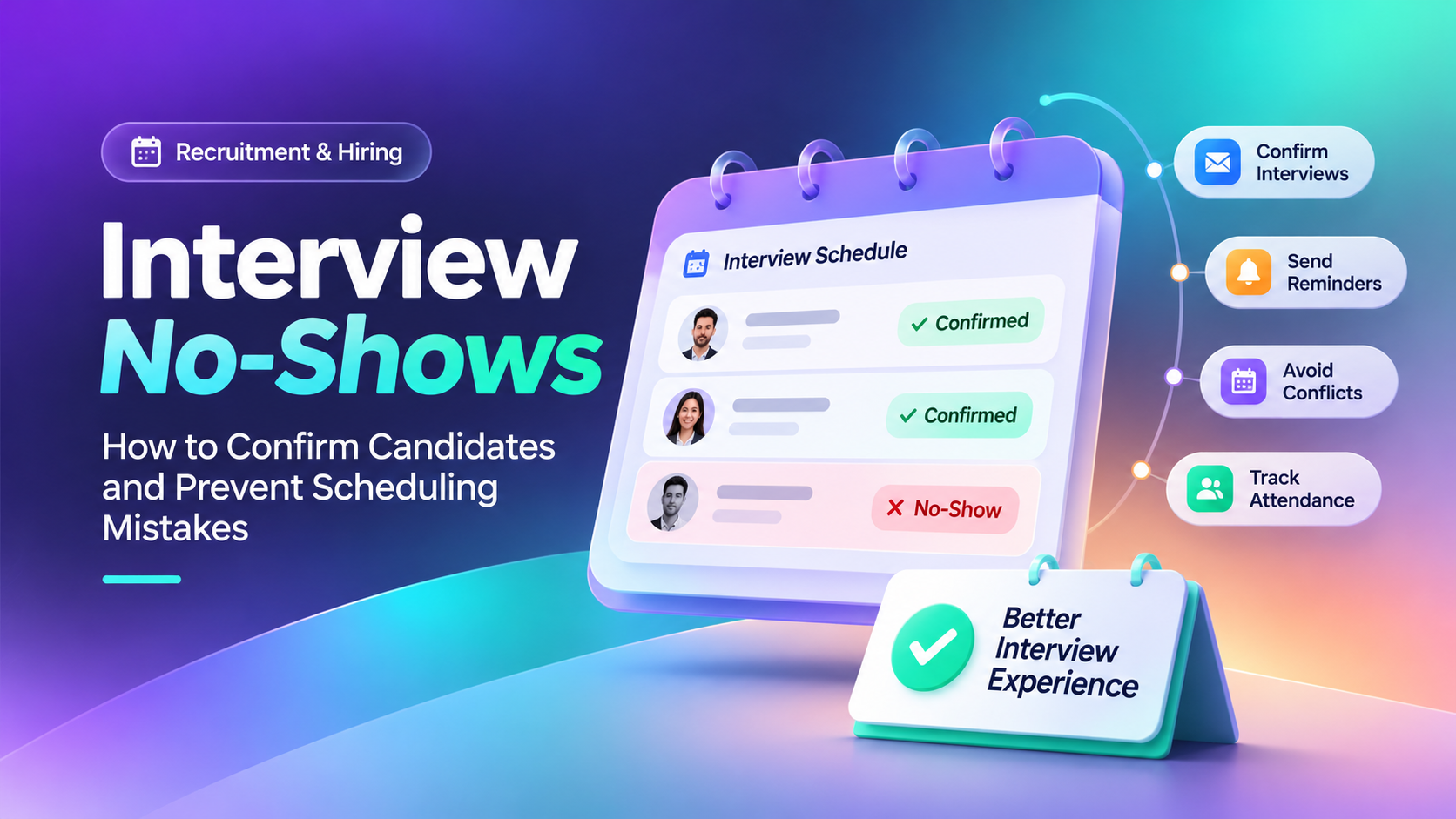
An interview no-show can waste valuable time for recruiters, hiring managers and candidates. However, not every missed interview happens because a candidate loses interest.
Incorrect meeting links, unclear interview instructions, last-minute schedule changes and missing confirmations can also cause attendance problems.
To reduce interview no-shows, businesses should confirm interview details, send timely reminders, verify interviewer availability and maintain accurate candidate records.
A structured recruitment scheduling process helps teams identify genuine absences without confusing them with administrative mistakes.
What Is an Interview No-Show?
An interview no-show occurs when a candidate fails to attend a scheduled interview without notifying the employer beforehand.
However, hiring teams should distinguish between several situations.
Situation | Meaning |
|---|---|
Attended | Candidate arrives as expected |
Awaiting confirmation | Candidate has not confirmed availability |
Cancelled | Interview was cancelled before its scheduled time |
Rescheduled | Interview was moved to another time |
No-show | Candidate did not attend a valid scheduled interview |
Scheduling error | Incorrect details or internal coordination caused a problem |
These distinctions are important because an unconfirmed interview should not automatically be treated as a candidate no-show.
Similarly, candidates should not be penalised for incorrect addresses, outdated meeting links or changes they were never informed about.
Why Do Candidates Miss Interviews?
Candidates may miss interviews for several reasons, including genuine emergencies and avoidable communication problems.
1. Unclear Interview Details
Candidates might receive a date and time without knowing whether the interview is online or in person.
Missing information about the location, meeting link, interviewer or time zone can create confusion.
2. Last-Minute Scheduling Changes
A recruiter may move an interview without ensuring the candidate receives the revised details.
If the previous calendar invitation remains active, both parties could follow different schedules.
3. Missing Reminders
Candidates may forget appointments scheduled several days earlier, particularly when managing multiple job applications.
Clear reminders help keep the interview visible.
4. Conflicting Commitments
Work obligations, travel difficulties and personal emergencies may prevent attendance.
Providing an easy rescheduling option can help candidates communicate changes instead of disappearing.
5. Poor Internal Coordination
Sometimes the candidate arrives, but the interviewer is unavailable or reception cannot find the booking.
This is a scheduling failure, not necessarily a candidate no-show.
How to Confirm Candidates Before an Interview
A clear confirmation process helps recruiters determine whether candidates have received and acknowledged the interview details.Give candidates a clear way to request a different time or reasonable adjustments to the interview process. Consider accessibility needs, existing work commitments and location or technology limitations without treating such requests as negative evidence of suitability
Step 1: Verify Candidate Contact Information
Before scheduling, confirm the candidate's email address and preferred communication method.
Incorrect contact information can prevent invitations and reminders from reaching the intended recipient.
Step 2: Send a Complete Interview Invitation
Every interview confirmation should include:
Job title and company name.
Interview date and start time.
Time zone and expected duration.
Online meeting link or physical address.
Interview format and preparation instructions.
Contact person for assistance.
Instructions for cancellation or rescheduling.
Candidates should not have to contact HR simply to understand where or when they need to attend.
Step 3: Request Confirmation
Ask candidates to acknowledge that they can attend.
A simple response such as "Confirmed" can help recruiters distinguish accepted appointments from those still awaiting a reply.
Remember that accepting a calendar invitation and physically attending an interview are different events.
Step 4: Send Timely Reminders
Consider sending reminders approximately 24 hours before the interview and shortly before the scheduled time.
These are suggested operating intervals, not guaranteed methods of preventing no-shows.
Reminders should repeat the essential details and explain how to report an unexpected problem.
A Practical Interview Scheduling Example
Consider a fictional company hiring a Software Developer.
The recruiter schedules an interview for Rahul on Friday at 11:00 AM.
Rahul receives an email containing the interview details and confirms his availability.
The recruiter then checks the interviewer's calendar and prepares the necessary interview information.
On Friday, Rahul arrives at reception at 10:50 AM.
The receptionist finds Rahul on the scheduled interview list and marks his arrival against the existing interview record.
The interviewer receives the arrival update and conducts the interview.
Afterward, the recruiter records the outcome against Rahul's job application.
This workflow maintains a clear connection between the candidate, scheduled interview, attendance and hiring decision.
The important principle is that interview attendance should remain connected to the candidate's recruitment record, rather than requiring an unrelated CRM sales lead.
How to Prevent Interview Scheduling Mistakes
Even when candidates confirm their availability, poor scheduling processes can still create problems.
Avoid Duplicate Interview Bookings
Before creating a new interview, check whether the candidate already has an appointment for the same position.
When an interview is rescheduled, update the existing booking where possible instead of creating conflicting appointments.
Check Interviewer Availability
Review the interviewer's working hours, existing commitments and required preparation time.
For panel interviews, verify every participant's availability.
Use Consistent Time Zones
Remote candidates and interviewers may work in different regions.
A clear invitation should identify the correct time zone and display scheduling information consistently.
Keep One Accurate Interview Record
Recruitment teams should avoid storing conflicting interview statuses across spreadsheets, email threads and different calendars.
The candidate's application should provide a reliable reference for the current interview.
Provide Clear Rescheduling Instructions
Candidates should know whom to contact if they cannot attend.
When an interview is moved, update the schedule and notify all relevant participants.
What Should Recruiters Do When a Candidate Does Not Attend?
Before recording a no-show, recruiters should verify that the interview was correctly scheduled.
A practical process includes five steps:
Check the confirmed schedule. Verify the date, time, location and meeting link.
Allow a reasonable grace period. Follow the company's attendance policy rather than immediately marking the candidate absent.
Contact the candidate. Use an appropriate communication channel to check whether they are experiencing difficulties.
Review internal scheduling errors. Confirm that the interviewer, meeting room and invitation details were correct.
Record the correct outcome. Mark the interview as attended, rescheduled, cancelled or no-show based on the available evidence.
Where appropriate, offer another interview opportunity.
A single missed interview should not automatically become a permanent negative judgement about the candidate.
How Recruitment and Appointment Software Can Help
Recruitment software and appointment scheduling tools serve complementary purposes.
Recruitment software manages candidates, applications, interview stages and hiring decisions.
Appointment scheduling software helps coordinate availability, booking times, confirmations and reminders.
When these workflows are connected correctly, the recruitment team can maintain a clear picture of scheduled interviews and candidate attendance.
However, businesses should verify how their chosen systems exchange information, manage duplicate bookings and record attendance.
A scheduling tool should support the hiring process without creating unnecessary customer or sales records for recruitment activities.
Where TrueValue Platform Fits
TrueValue Platform provides separate Products for recruitment and appointment management.
TrueValue Recruit covers job postings, candidate management, hiring pipelines, interview scheduling and offer workflows.
TrueValue Appointments supports booking management, staff availability, confirmations, reminders and rescheduling.
For interview operations, the candidate's recruitment record should remain the authoritative source for hiring-related information.
Businesses evaluating these Products should confirm how their intended recruitment and scheduling workflows are supported, including interview attendance, status updates and notifications.
Frequently Asked Questions
How can HR reduce candidate interview no-shows?
Send complete interview invitations, request confirmation, provide reminders, verify interviewer availability and make rescheduling easy.
Should an unconfirmed candidate be marked as a no-show?
No. Lack of confirmation does not prove that a candidate missed a valid scheduled interview.
Should recruiters automatically reject candidates who miss interviews?
Not necessarily. Recruiters should verify the circumstances and follow a consistent, job-related attendance policy.
Can appointment scheduling software manage job interviews?
It can help manage bookings and availability, but recruitment records, interview feedback and hiring outcomes should remain connected to the candidate's application.
What happens if a candidate arrives but reception cannot find the booking?
The team should verify the scheduled interview and resolve the record mismatch before assigning an attendance outcome. It should not automatically mark the candidate as absent.
Conclusion: Better Scheduling Creates a Better Interview Experience
Reducing interview no-shows requires more than sending calendar invitations.
Businesses need clear communication, reliable confirmations, accurate schedules and consistent attendance records.
A structured process helps recruiters distinguish genuine absences from scheduling mistakes while protecting the candidate experience.
Want to organise your hiring and interview workflows more effectively?
Explore TrueValue Recruit to review its recruitment capabilities and available plans.
See Business Operations and the rest of the Platform in action.
Start with the Product you need today, then add more on the same Platform.
Explore Products