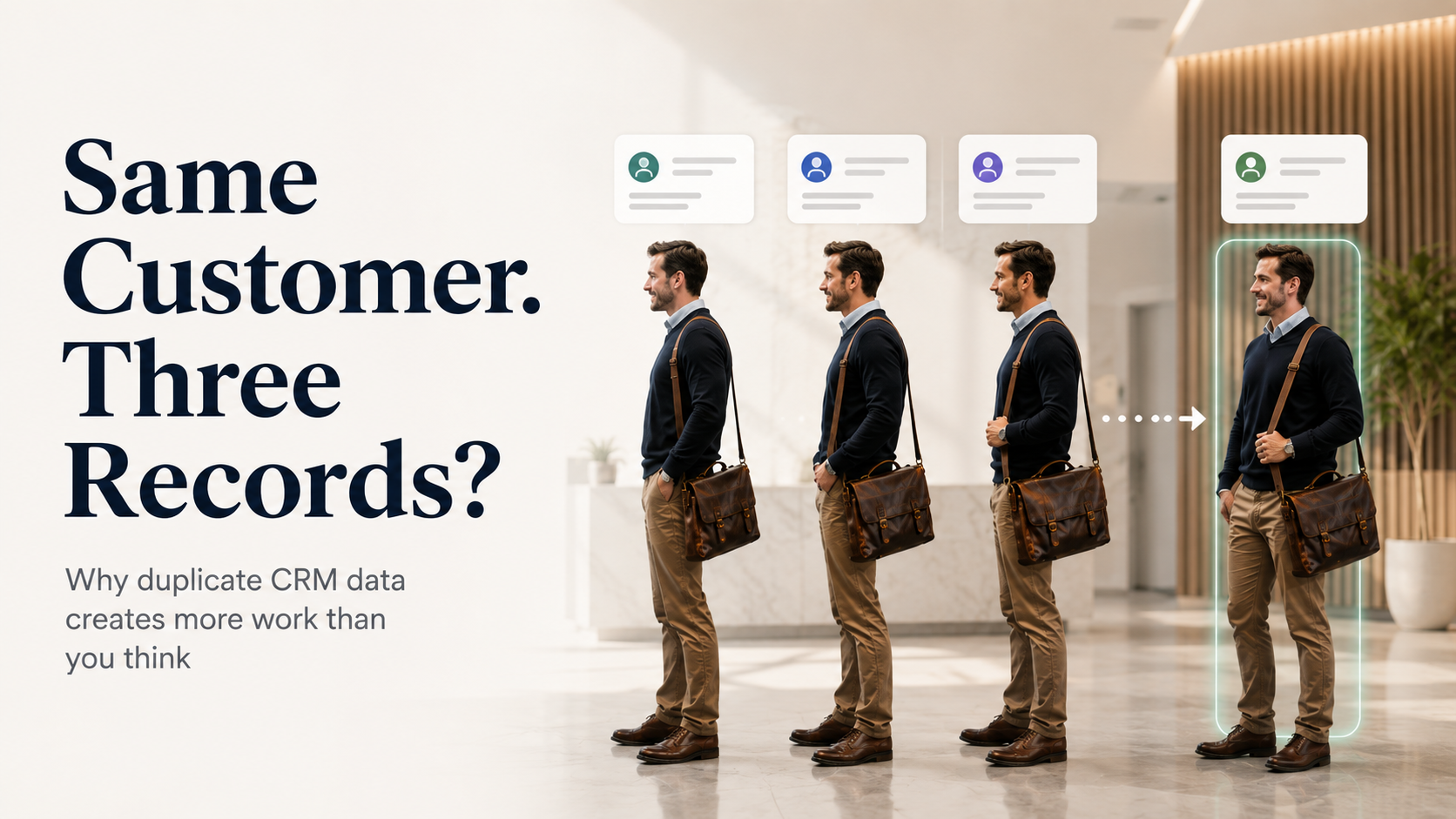
A customer fills out a form.
A few days later, they call your sales team using a different phone number.
Then another team member adds them manually using a slightly different name.
Suddenly, one customer has become three CRM records.
John Smith.J. Smith.John Smith — Updated.
It may look like a minor database issue.
But duplicate customer records can quickly create a much bigger operational problem.
Different employees may work from different records. Follow-up notes can become scattered. Customer history gets fragmented. Reporting becomes less reliable. And your team spends more time trying to understand information that should already be clear.
For growing businesses, having more customer data is not necessarily the goal.
Having clearer customer information is.
What Is a Duplicate Customer Record?
A duplicate customer record exists when information relating to the same person or business appears more than once inside your CRM.
The records might not look exactly the same.
One could contain:
A full name
A work email address
An office phone number
Another might contain:
A shortened name
A personal email address
A mobile number
And a third record could contain a newer enquiry or updated contact information.
To someone quickly reviewing the CRM, these can appear to be three different customers.
In reality, your team may be looking at three incomplete versions of the same relationship.
Why Do Duplicate Records Happen?
Duplicate records are not always caused by careless data entry.
They often develop naturally as a business grows.
Customers can contact a company through different channels. Multiple employees may enter information. People change phone numbers or email addresses. Names are written differently. An existing customer may submit another website enquiry months later.
For example:
John SmithJ. SmithJohn A. Smith
To a person, the similarity may seem obvious.
But when customer information is spread across different records, channels and employees, identifying the correct customer history becomes harder.
And as the database grows, the problem can grow with it.
The Real Cost of Duplicate CRM Data
Duplicate records affect much more than how tidy your database looks.
1. Follow-Ups Become Confusing
Imagine one salesperson updates Customer Record A after a call.
Another employee opens Customer Record B and sees no recent activity.
They may contact the customer again without knowing somebody else has already spoken to them.
From inside the business, it is a data problem.
From the customer's perspective, it can feel like the company does not know what is happening.
2. Teams Repeat Work
Duplicate records can contribute to:
Repeated calls
Repeated qualification questions
Duplicate follow-up activity
Extra searching
Employees checking several records before taking action
Individually, these tasks may only waste a few minutes.
Repeated across hundreds of customer interactions, they create unnecessary operational friction.
3. Customer History Becomes Fragmented
A useful CRM should help authorised users understand the customer relationship without having to reconstruct it manually.
But imagine:
Record 1: Original enquiryRecord 2: Latest phone conversationRecord 3: Updated contact information
No single record gives the employee the complete picture.
Before the next conversation, somebody has to piece the information together.
That slows down work and increases the possibility of important context being missed.
4. Reporting Can Become Less Useful
Suppose your CRM contains 5,000 customer records.
How many represent unique customers?
If some customers appear multiple times, simple record counts may not give your team the clearest picture of the database.
Duplicate information can also complicate how teams interpret activity, customer engagement and follow-up workload.
Cleaner customer information helps make the CRM more useful not only for individual employees, but also for managers reviewing the bigger picture.
5. Personalised Conversations Become Harder
Good customer conversations depend on context.
Has this person contacted the business before?
What were they interested in?
Who last spoke to them?
What was discussed?
What needs to happen next?
When customer information is fragmented across multiple records, employees may begin a conversation without the context already available elsewhere in the business.
A clearer customer view can make it easier to understand the relationship before the next interaction begins.
What Does a Cleaner Customer Identity Look Like?
The objective is not simply to delete records.
It is to help teams work from customer information that is easier to understand and maintain.
A practical CRM process should make questions like these easier to answer:
Is this customer already in our CRM?
Which customer record should we work from?
What interactions have already happened?
Who owns the next action?
Is the contact information current?
Is important customer context sitting somewhere else?
When employees can answer those questions without searching across several disconnected records, customer information becomes more useful.
Preventing Duplicate Records Matters Too
Cleaning an existing CRM database can help.
But if the same process continues creating duplicates, the problem eventually returns.
Businesses should therefore consider how customer information enters and moves through their CRM.
Simple practices can help, including:
Checking for an existing customer before creating a new record
Using consistent naming and contact-data conventions
Reviewing suspicious or incomplete records periodically
Keeping customer ownership clear
Updating existing information instead of unnecessarily creating another record
Training customer-facing employees on basic CRM data-quality practices
The important principle is simple:
Customer data quality should be part of everyday CRM workflow — not only a clean-up project carried out once a year.
More Records Do Not Always Mean Better Customer Data
Businesses naturally want to capture more enquiries, prospects and customer information.
But database size alone does not determine CRM quality.
A CRM becomes more useful when the people using it can quickly understand who the customer is, what has already happened and what needs to happen next.
That means moving from:
More records
to:
Better-organised customer information.
For founders, sales managers and customer-facing teams, that can mean less searching, clearer follow-up and a more understandable view of customer relationships.
Build a Clearer CRM Workflow with TrueValue Platform
TrueValue Platform brings purpose-built business Products together on one connected Platform, including CRM.
If fragmented customer information and unclear follow-ups are creating unnecessary work for your team, it may be worth reviewing how your CRM workflow is organised.
Explore TrueValue Platform Products:
https://truevalueplatform.com/all-products
Ready to See TrueValue Platform CRM?
See how TrueValue Platform CRM can support a more organised approach to customer information and follow-up.
Request a Demo →https://truevalueplatform.com/request-a-demo