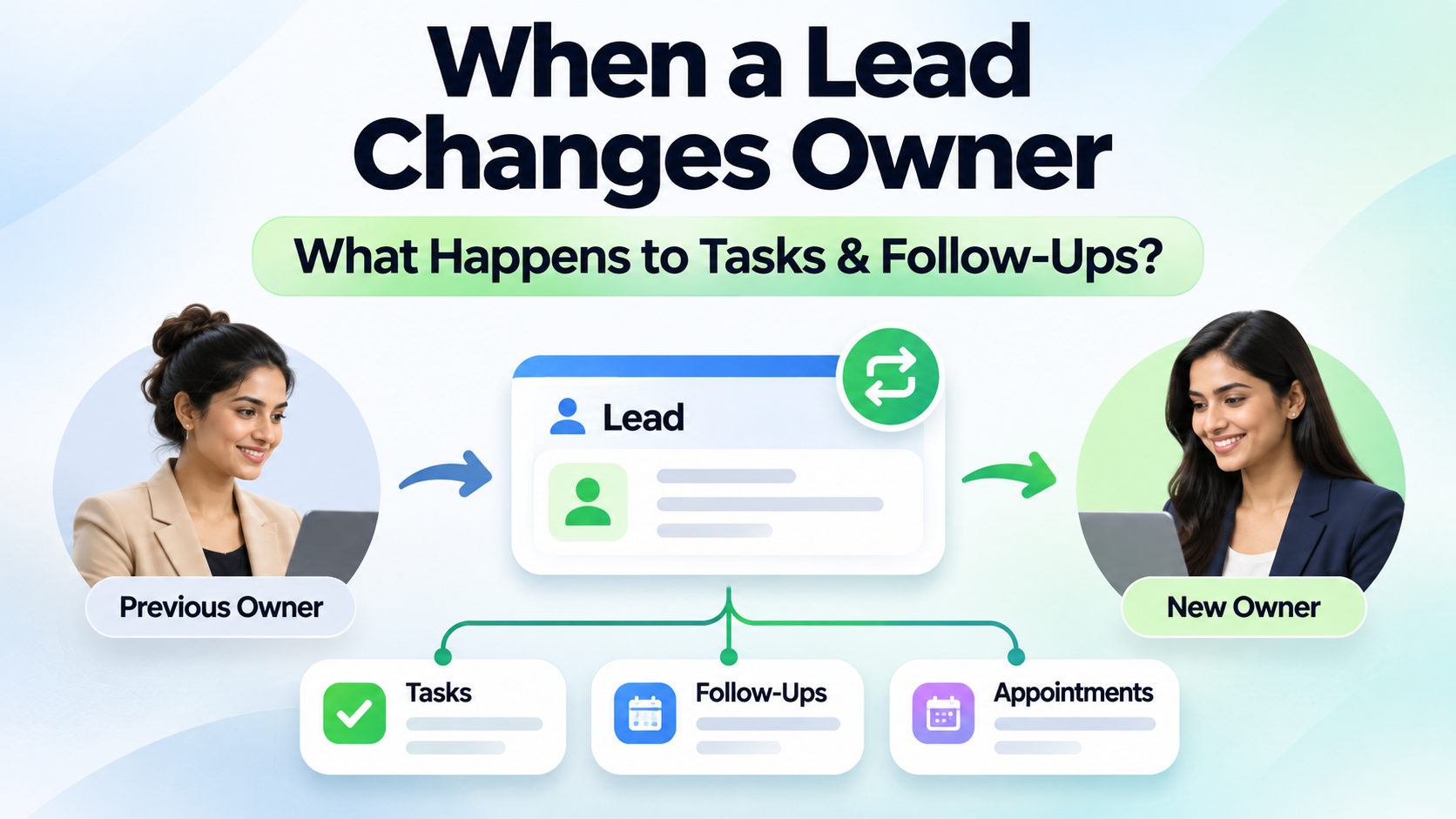
Changing a lead owner in a CRM should not result in missed follow-ups, forgotten tasks or lost customer information. However, these problems can occur when businesses transfer leads without reviewing their associated activities.
When a lead changes owner, pending tasks, scheduled follow-ups and customer history should be reviewed to ensure a smooth handover. Whether these activities transfer automatically depends on the CRM system and its configuration.
Understanding this process helps businesses maintain accountability and prevent interruptions in customer communication.
What Happens When a CRM Lead Changes Owner?
A lead ownership change transfers responsibility for managing a potential customer from one employee to another.
This commonly happens when:
An employee leaves the organisation.
A salesperson takes extended leave.
A manager redistributes workloads.
A lead remains inactive for an extended period.
A customer moves to another team.
However, changing the lead owner does not necessarily transfer every associated activity.
A CRM lead may contain pending tasks, scheduled calls, appointments, automated emails and previous communication records.
Lead ownership and task ownership are separate responsibilities. Businesses should define how each is handled during reassignment.
Lead Owner vs Task Owner: What's the Difference?
A lead owner manages the overall customer relationship, while a task owner is responsible for completing a specific activity.
Responsibility | Lead Owner | Task Owner |
|---|---|---|
Customer relationship | Primary responsibility | Not necessarily |
Assigned follow-up calls | May handle | Responsible |
Customer history | Reviews | Accesses when needed |
Specific task completion | Not automatically | Responsible |
Overall lead progress | Monitors | Contributes |
For example, a sales manager may own a lead while another employee handles document collection.
Changing the lead owner should not automatically remove the document collection task from that employee.
The appropriate behaviour depends on the company's workflow.
What Happens to Pending Tasks and Follow-Ups?
Pending activities require particular attention during reassignment.
Imagine a salesperson promises to contact a customer on Friday but leaves the organisation on Wednesday.
If the lead moves to another employee while the reminder remains assigned to the previous owner, the customer may never receive the promised call.
A reliable handover should address five types of activities.
1. Overdue Tasks
Overdue tasks should remain visible and receive priority during reassignment.
The new owner needs to understand what was expected and whether the customer has already been contacted.
2. Upcoming Follow-Ups
Scheduled follow-ups should generally retain their original deadlines.
A change in ownership should not silently delay customer commitments.
3. Completed Activities
Completed tasks should remain in the customer history.
They help the new owner understand previous conversations and avoid repeating completed work.
4. Tasks Assigned to Other Employees
Not every task needs to move.
Activities assigned to finance, support or another specialist may remain with their existing owners.
5. Automated Reminders
Automated emails and reminders should be reviewed to ensure they reach the correct employee or customer.
Otherwise, outdated or duplicate communications may occur.
How Lead Reassignment Can Affect Sales Productivity and Revenue Opportunities
A lead ownership change can affect more than an employee's workload. It can interrupt a customer conversation that was already moving towards a decision.
Consider a customer who has requested a proposal and is expecting a follow-up on Friday. If the lead is transferred to another salesperson but the pending task remains with the previous owner, the promised call may be missed.
The new employee might eventually discover the issue, but the team has already spent additional time identifying the next action. The customer may also have to repeat information or wait longer for a response.
For sales managers, the important questions are:
Which reassigned leads still have overdue follow-ups?
Who is responsible for the next customer interaction?
Are open opportunities progressing after a handover?
Are scheduled appointments and previously agreed deadlines still valid?
Can the new owner review the information needed to continue the conversation?
These checks can help managers identify avoidable delays and duplicated work.
The objective is not simply to change ownership quickly. It is to maintain clear responsibility for the next action while keeping active customer opportunities moving.
A CRM evaluation should therefore consider lead ownership, follow-up visibility, customer history and reporting together rather than treating reassignment as an isolated administrative change.
Example: Transferring a Customer from Preeti to Dipali
Consider a fictional visa consultancy managing enquiries through a CRM.
Rahul contacts the company regarding an Australian visa and is assigned to Preeti.
Preeti records the following activities:
Activity | Status |
|---|---|
Initial consultation | Completed |
Request missing documents | Pending |
Review qualifications | Pending |
Send fee information | Completed |
Arrange appointment | Scheduled |
Later, Preeti becomes unavailable, and Rahul is reassigned to Dipali.
A proper handover should ensure that:
Dipali can review Rahul's previous communication.
Pending document and qualification tasks have clear owners.
The scheduled appointment is reviewed.
Completed activities remain unchanged.
Rahul does not receive duplicate requests.
The CRM should also retain an appropriate record of the ownership change.
This example illustrates a recommended business process. Actual automatic reassignment behaviour varies between CRM products.
Should Tasks Transfer Automatically?
Businesses can generally choose between three task reassignment approaches.
Option 1: Transfer All Open Tasks
Every unfinished task moves to the new lead owner.
This may suit smaller teams where one employee handles the complete customer journey.
However, specialist tasks could be transferred unnecessarily.
Option 2: Transfer Only the Previous Owner's Tasks
Unfinished tasks assigned to the previous lead owner transfer to the new owner.
Activities assigned to other employees remain unchanged.
This is often a practical starting approach for teams with shared responsibilities.
Option 3: Review Tasks Individually
A manager decides which activities should transfer.
This offers greater control but requires additional administrative work.
For complex organisations, a configurable reassignment policy can help balance automation with managerial oversight.
What Happens to Scheduled Appointments?
Appointments require separate consideration because they may involve calendar invitations, meeting links and assigned hosts.
Changing a CRM lead owner does not necessarily update an existing appointment.
Before completing the transfer, verify:
Whether the original appointment host remains available.
Whether the new owner should attend.
Whether calendar invitations need updating.
Whether the customer needs notification.
Avoid creating duplicate appointments simply because ownership changes.
The goal is to maintain one accurate booking with clearly assigned responsibility.
What Happens to Automated Emails?
Automated follow-up sequences can continue after a lead changes owner, depending on their configuration.
For example, an email scheduled by the previous owner may still be waiting to send.
Without reviewing the automation, the customer could receive an outdated message or duplicate communication.
Businesses should check scheduled messages, sender details, sequence status and communication preferences.
A lead reassignment should preserve communication continuity rather than restart every customer interaction.
Should Customer History Remain Available?
Yes. The new owner should have access to relevant customer information according to organisational permissions.
Previous notes, completed tasks, conversations and important commitments should remain available.
However, historical records should not be rewritten to suggest that the new owner completed work performed by someone else.
For example, if Preeti completed Rahul's initial consultation, that activity should continue to identify Preeti.
Dipali can then review the record and continue the relationship.
This preserves accountability and reduces repeated questions.
How to Reassign Leads Without Missing Follow-Ups
A structured handover process can reduce operational mistakes.
Step 1: Identify the reassignment reason. Determine whether the transfer is temporary or permanent.
Step 2: Review pending activities. Check overdue tasks, upcoming reminders, appointments and scheduled messages.
Step 3: Select the new owner. Confirm that the employee has appropriate responsibility and access.
Step 4: Apply task transfer rules. Decide which unfinished activities should move.
Step 5: Preserve customer history. Retain previous notes, conversations and completed tasks.
Step 6: Notify the new owner. Provide a summary of urgent activities and upcoming deadlines.
Step 7: Verify the handover. Ensure no important activity remains assigned to an unavailable employee.
Where supported, maintain an audit trail recording the previous owner, new owner, reassignment date and reason.
Common Lead Reassignment Mistakes
Businesses should avoid several common problems:
Ignoring pending tasks: Important follow-ups remain assigned to unavailable employees.
Deleting historical activities: Valuable customer context disappears.
Changing deadlines unnecessarily: Customer commitments are delayed.
Duplicating appointments: Multiple employees contact the same customer.
Ignoring automated messages: Customers receive conflicting communications.
Failing to notify the new owner: The employee receives responsibility without sufficient context.
Clear reassignment policies help prevent these issues.
How TrueValue CRM Supports Lead Management
TrueValue CRM is part of TrueValue Platform's business software offering, focused on organising leads, customer relationships, deals and sales activities.
For businesses evaluating CRM software, lead ownership, follow-up visibility, task responsibility and customer history are important considerations.
Before choosing a system, verify how its available configuration handles ownership changes, task reassignment and automated communications.
The recommended practices in this article are general CRM guidance, not a claim that every reassignment option is automatically available in TrueValue CRM.
Frequently Asked Questions
Does changing a lead owner automatically transfer tasks?
Not always. Task reassignment depends on the CRM platform and its configuration.
What happens to completed follow-ups?
Completed activities should remain in the customer's history, preserving the original employee's contribution.
Can two employees work on the same lead?
Yes, where permissions allow. One employee may own the lead while another handles specific tasks.
How can businesses prevent missed follow-ups?
Review unfinished activities, preserve deadlines, assign clear responsibility and notify the new owner.
Conclusion: Lead Reassignment Should Not Interrupt Customer Relationships
Changing a lead owner involves more than updating an employee's name.
Businesses should ensure pending tasks have clear owners, scheduled appointments remain accurate and previous customer information stays accessible.
A structured reassignment process helps teams maintain accountability and provide consistent customer service.
Looking for a clearer way to organise leads and sales follow-ups?
Explore TrueValue CRM Plans & Pricing to compare the available options for your business.
See CRM and the rest of the Platform in action.
Start with the Product you need today, then add more on the same Platform.
Explore Products