A campaign can deliver hundreds of leads and still disappoint the sales team. The advertising report looks promising, but the appointment calendar tells another story: some enquiries never receive a reply, some people do not book, and others miss their consultation.
Cost per attended consultation measures how much a business spends on advertising to generate one consultation that actually takes place. Divide attributable campaign spend by the number of attended consultations linked to that campaign. Count real attendance, not clicks, messages or unconfirmed bookings.
This distinction helps business owners, marketing managers and service teams judge campaigns by meaningful conversations rather than lead volume alone.
What Is Cost per Attended Consultation?
Cost per attended consultation is a campaign-efficiency metric. It answers: How much advertising money did we spend for each consultation that genuinely happened?
It is different from cost per lead (CPL), which measures enquiries, and cost per booked appointment, which measures confirmed slots. None of these automatically tells you whether a meeting occurred or resulted in a paying customer.
An attended consultation may be an in-person office visit, a completed video meeting or a telephone appointment, depending on the business. Agree on what counts before preparing reports. A booking confirmation alone is not attendance; an unanswered call is not a completed telephone consultation.
Also distinguish media-only cost from fully loaded cost. The first includes advertising spend. The second may add relevant creative production, agency fees, tools and staff costs. Do not compare one campaign's media-only cost with another's fully loaded figure.
The calculations in this article use advertising spend only. They are not a complete measure of the cost of delivering a consultation, which may also involve staff time, facilities, travel, agency fees and other relevant operating costs.
How to Calculate the Real Cost of an Attended Consultation
Media cost per attended consultation = Attributable advertising spend ÷ Attended consultations attributed to that spend
To understand why that figure changes, track the whole funnel:
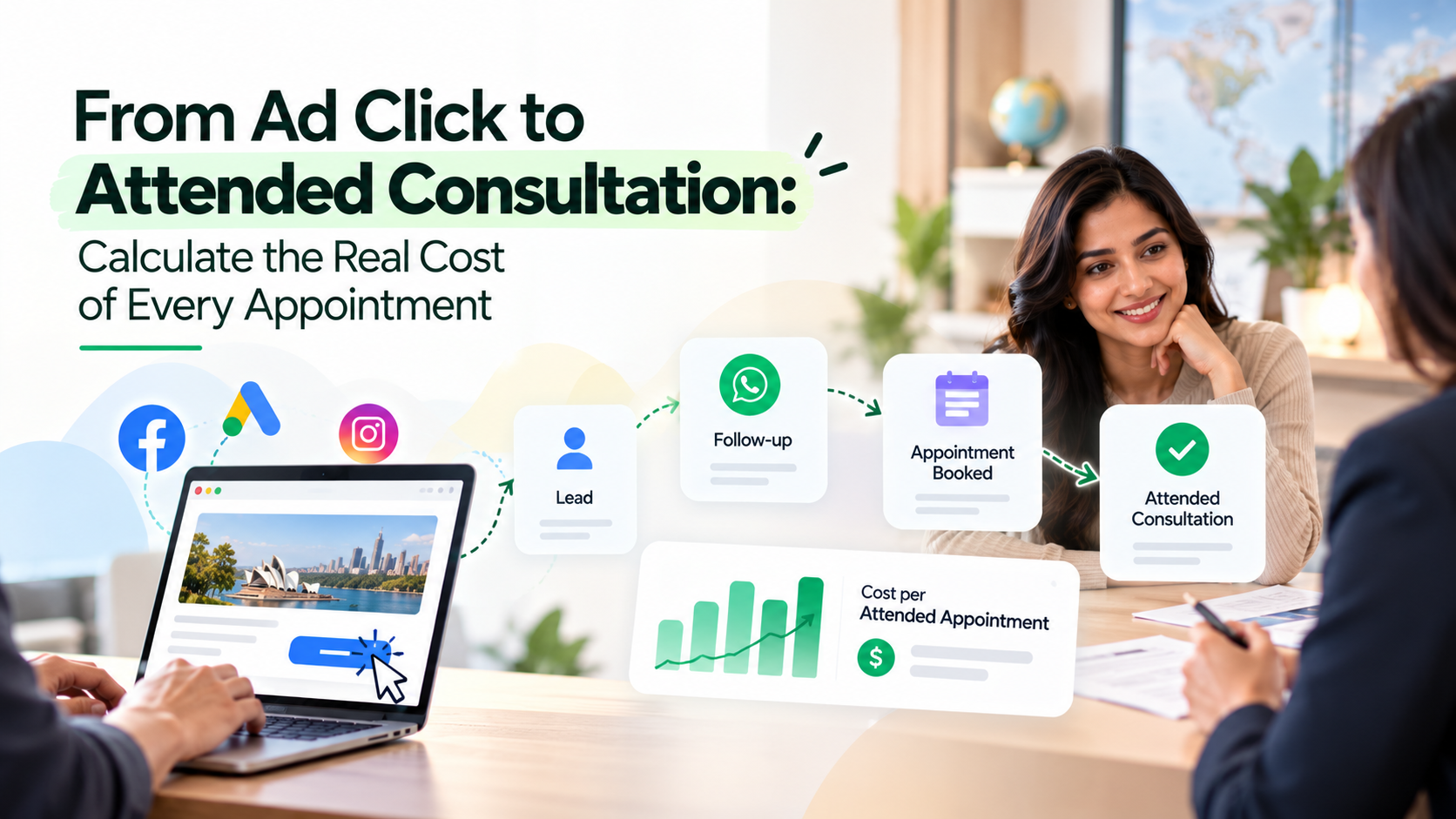
Ad clicks → Leads → Qualified leads → Booked consultations → Attended consultations → Customers
Five useful calculations are:
Metric | Formula |
|---|---|
Cost per lead | Ad spend ÷ unique leads |
Cost per qualified lead | Ad spend ÷ qualified leads |
Cost per booked consultation | Ad spend ÷ confirmed bookings |
Booking attendance rate | Attended consultations ÷ bookings due for an attendance outcome × 100 |
Cost per attended consultation | Ad spend ÷ attended consultations |
The denominator matters. Exclude future appointments when assessing attendance, identify cancellations and reschedules separately, and decide whether your report counts unique first consultations or all attended sessions. For comparing acquisition campaigns, counting each new prospect's first attended consultation is often the clearest approach.
If a campaign has no attended consultations, report its cost per attendance as not available, rather than zero. There is no meaningful division by zero.
Example: Why the Cheapest Leads May Cost More
Consider two fictional campaigns promoting the same consultation service. Both spend ₹24,000 during a defined acquisition period. Attendance is followed through a suitable reporting window so appointments booked near the end are not overlooked.
Funnel stage | Campaign A | Campaign B |
|---|---|---|
Advertising spend | ₹24,000 | ₹24,000 |
Ad clicks | 1,200 | 800 |
Unique leads | 240 | 120 |
Qualified leads | 120 | 90 |
Confirmed bookings | 60 | 54 |
Attended first consultations | 36 | 45 |
Cost per lead | ₹100 | ₹200 |
Cost per booked consultation | ₹400 | ₹444.44 |
Cost per attended consultation | ₹666.67 | ₹533.33 |
Campaign A wins on cost per lead: ₹100 versus ₹200. But Campaign B produces nine more attended consultations for the same spend, reducing cost per attendance by about ₹133.
Campaign B's booking attendance rate is 83.3% (45 ÷ 54), versus 60% (36 ÷ 60) for Campaign A, assuming these bookings have reached final attendance outcomes.
Better lead qualification, more convenient booking times or clearer follow-up might explain the difference; the table alone does not prove the cause.
All figures are illustrative, not actual TrueValue results or market benchmarks.
How to Track the Journey From Ad Click to Attendance
1. Preserve the original campaign source
At enquiry creation, capture the channel, campaign and available ad identifiers. For website traffic, standard UTM parameters such as utm_source, utm_medium and utm_campaign help label where visits originated. Google Analytics explains manual and automatic campaign tagging.
A WhatsApp conversation or telephone enquiry may need a different source-capture method. A click on an advertisement does not automatically prove that a later office visit belongs to that campaign. Preserve a reliable identifier when a lead enters your process.
Define how campaign credit is assigned—for example, using a consistent first-touch or last-touch rule—and apply that method across the reporting period. Keep consultations with unknown sources in an unattributed category rather than assigning them to a campaign without evidence.
2. Give each enquiry one trackable identity
Use a unique lead reference. Record the date, campaign source, qualification outcome and owner, while handling personal data according to your privacy responsibilities. Merge genuine duplicate enquiries under a consistent rule without deleting their history.
This matters because one person may submit two forms, send three messages and reschedule twice. Those actions should not be presented as multiple new customers.
3. Record confirmed bookings separately
An interested lead is not necessarily an appointment. Record the booking identifier, scheduled date, responsible staff member, location or meeting type, and current status. Distinguish requested time slots from genuinely confirmed bookings.
When a meeting moves, preserve the original booking history and identify the replacement slot. Otherwise, a reschedule may appear as both a cancellation and an additional successful booking.
4. Verify what actually happened
After the appointment time passes, assign an outcome such as attended, no-show, cancelled, rescheduled or pending verification. The person responsible for the consultation should confirm attendance rather than rely solely on a calendar entry.
Measure qualified attended consultations separately if your commercial goal requires them. An attended meeting with someone outside your target audience may have less value than an attended meeting with a genuine prospective buyer.
5. Reconcile spending with the correct lead cohort
Avoid dividing this week's advertising spend by every consultation that happened this week. Some attendees may have responded to earlier campaigns, while this week's enquiries may attend next month.
Instead, select a campaign acquisition period and follow those leads through a defined attendance window. Report still-open bookings separately. Keep unattributed consultations visible rather than guessing which campaign deserves credit.
For businesses measuring offline outcomes, Google Ads supports enhanced conversions for leads, subject to correct implementation, consent and matching. Its documentation should guide any technical setup; measurement is not automatically complete simply because an analytics tag is installed.
Which Conversion Events Should You Measure?
Google Analytics 4 recommends generate_lead for an enquiry and qualify_lead when a lead meets qualification criteria. It also documents working_lead for sales contact activity.
Attended consultation is a distinct business outcome, not a synonym for generate_lead or close_convert_lead. Where appropriate, define a separate attendance event and validate its data source. If GA4 cannot receive reliable offline attendance information, use a reconciled appointment report rather than inventing an event count.
Advertising platforms can also apply different attribution windows, models and conversion-counting settings. Therefore, an ad dashboard's conversion total may not equal the number of distinct people who attended. Google Ads explains its conversion counting options.
Five Mistakes That Inflate Campaign Performance
Counting messages as unique leads. Multiple messages from one person may exaggerate enquiry volume. Define a lead consistently.
Treating booked appointments as attended. A confirmed slot is progress, but it is not evidence of a completed consultation.
Ignoring reschedules. If one customer changes dates repeatedly, count the attended first consultation once for the acquisition metric.
Mixing reporting periods. Comparing advertising spend and unrelated appointment dates can falsely favour or penalise campaigns.
Reporting only paid-platform conversions. Review actual qualification, attendance and subsequent customer outcomes. Platform-reported credit and operational records serve different purposes.
How to Lower Cost per Attended Consultation
Start by identifying the weakest funnel stage rather than immediately increasing or cutting ad budgets.
If leads are plentiful but few qualify, inspect targeting, advertising claims and enquiry questions. If qualified prospects rarely book, examine response speed, staff ownership and available appointment slots. If many people book but do not attend, improve confirmation details and make cancellation or rescheduling straightforward.
After attendance improves, measure whether the consultations progress to proposals, registrations or paying customers.
Lower cost per attended consultation does not automatically mean higher profit: sales quality, staffing costs and customer value still matter.
For related guidance, TrueValue has a practical article on what should happen after someone submits a website form.
Where TrueValue Platform Fits
TrueValue Platform offers purpose-built Products addressing different parts of this journey: Marketing for campaign audiences and communication operations, CRM for leads and follow-ups, and Appointments for bookings, staff availability and scheduling.
The reporting framework here is educational. It does not claim that these Products automatically connect every advertisement, message or attendance record, or that all calculations are built-in features.
Businesses can evaluate their actual workflow and requirements through a TrueValue Platform demo.
Frequently Asked Questions
Is cost per lead the same as cost per attended consultation?
No. Cost per lead divides advertising spend by enquiries. Cost per attended consultation divides attributable spend by consultations that actually happened. They evaluate different stages of the customer journey.
Should cancelled or rescheduled bookings count as attended?
No. Keep them in separate categories. For acquisition reporting, count the prospect's first completed consultation once, even when an earlier booking was moved.
Can I calculate this without a CRM?
Yes. Begin with an accurately maintained spreadsheet linking campaign references, leads, bookings and verified outcomes. As volume increases, evaluate how to reduce manual reconciliation without losing data quality.
Is this the same as customer acquisition cost?
No. Customer acquisition cost considers customers actually acquired and the costs included in the chosen methodology. An attended consultation may never become a customer, so it is an intermediate measure.
The Bottom Line
Ad clicks show recorded interactions with an advertisement. Leads show enquiries generated under your reporting rules. Attended consultations show which scheduled conversations actually took place.
Track each stage, match attendance to the correct campaign, and use cost per attended consultation alongside customer outcomes before deciding where to invest next.
See AI and the rest of the Platform in action.
Start with the Product you need today, then add more on the same Platform.
Request a Demo